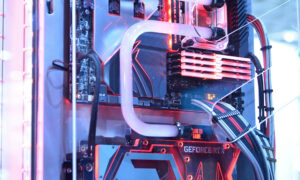
For decades, the image of a personal computer was dominated by the hulking tower case, a monolithic box that demanded real estate under or on a desk, woven with a tangled web of cables. However, a quiet revolution has been underway, championed by a new class of device: the Mini PC. These compact, often palm-sized computers have evolved from niche curiosities into powerful and versatile machines that are challenging the very definition of a desktop computer.
This article delves into the technology behind Mini PCs, their applications, and the market forces driving their increasing popularity.
Defining the Mini PC
A Mini PC is a small-form-factor (SFF) desktop computer designed for minimal space consumption and energy efficiency. While there’s no strict size definition, they are typically small enough to be mounted behind a monitor using a VESA bracket, effectively disappearing from view. They are distinct from traditional desktops in their lack of internal expansion slots and reliance on highly integrated components. They also differ from single-board computers (like the Raspberry Pi) by typically offering more performance, a pre-assembled chassis, and a dedicated focus on being a full-fledged desktop replacement.
Core Technology and Architecture
The heart of a Mini PC’s design is integration. The architecture revolves around a few key principles:
- SoC (System on a Chip): The most critical component is the SoC. This is where the CPU, GPU, memory controller, and often the chipset are all integrated onto a single silicon die. This dramatically reduces the physical footprint and power consumption compared to a traditional multi-chip motherboard design. Intel’s NUC (Next Unit of Computing) pioneered this concept using their U-series mobile processors, and AMD’s Ryzen APUs (Accelerated Processing Units) have become fierce competitors, offering exceptional CPU and integrated Radeon graphics performance in a tiny thermal design power (TDP) envelope.
- Memory and Storage: To save space, most Mini PCs use laptop-style components. SODIMMs (Small Outline Dual In-line Memory Modules) are the standard for RAM, and storage is almost exclusively via M.2 NVMe SSDs for blistering speed, sometimes accompanied by a 2.5-inch SATA bay for additional storage. The move away from bulky 3.5-inch HDDs is a key enabler of this small form factor.
- Thermal Design: Cooling a powerful computer in a confined space is a significant engineering challenge. Solutions range from passive, fanless designs using the chassis as a heat sink for ultra-low-power chips (ideal for silent operation in media centers) to active cooling systems featuring small, efficient fans and heat pipes. Advanced power management is crucial to balance performance and thermals, preventing throttling under sustained loads.
- Connectivity: Despite their size, modern Mini PCs are connectivity powerhouses. They are typically equipped with multiple USB ports (increasingly USB4/Thunderbolt 4), HDMI 2.1 and DisplayPort outputs for driving multiple 4K or even 8K displays, 2.5Gb Ethernet, and Wi-Fi 6/6E. This extensive I/O ensures they can serve as the hub for a complete workstation or entertainment center.
Applications and Use Cases
The versatility of Mini PCs has led to their adoption across a wide spectrum of applications:
- Home Theater PCs (HTPCs) and Media Centers: A classic use case. A Mini PC, running software like Plex or Kodi, can be hidden away near a TV, providing a silent, low-power platform for streaming, playing local 4K HDR content, and serving as a central media library.
- Corporate and Educational Desks: Businesses and schools are major adopters. Mini PCs reduce clutter, improve security (as the entire unit can be locked away), simplify IT management with standardized hardware, and consume far less electricity than a traditional desktop, leading to significant cost savings at scale.
- Digital Signage and Kiosks: Their small size and reliability make them perfect for driving displays in retail environments, museums, or as interactive information kiosks in airports and hotels.
- Lightweight Gaming and Indie Game Rigs: While not replacements for high-end gaming rigs with discrete GPUs, Mini PCs equipped with AMD’s Ryzen 7 APUs with Radeon graphics or Intel’s Core Ultra processors with Arc graphics are capable of handling esports titles (like CS:GO, League of Legends) and indie games at 1080p with respectable frame rates.
- Home Server and Network Attached Storage (NAS): Tech enthusiasts often use more powerful Mini PCs as lightweight home servers for file storage, running Docker containers, home automation software, or as a network-wide ad blocker.
- General Productivity: For the vast majority of users whose computing needs are web browsing, office applications, and video conferencing, a modern Mini PC offers more than enough performance in an elegant, space-saving package.
Market Trends and the Future
The Mini PC market is growing rapidly, fueled by several trends. The rise of remote work has led individuals to seek cleaner, more minimalist home office setups. Furthermore, greater awareness of energy efficiency is making low-power computing more attractive.
Looking ahead, we can expect several developments:
- AI Integration: With NPUs (Neural Processing Units) now integrated into chips like Intel’s Core Ultra (Meteor Lake), Mini PCs will become capable platforms for local AI inference tasks, from enhancing video conferencing backgrounds to managing smart home devices more intelligently.
- Even Better Graphics: The line between integrated and discrete graphics continues to blur. AMD’s RDNA architecture and Intel’s Xe graphics are providing levels of performance previously unthinkable in such a small TDP. External GPU enclosures connected via Thunderbolt also offer a path for users to add desktop-grade graphics when needed.
- Specialized Form Factors: We will see more ruggedized Mini PCs for industrial environments and even smaller “stick” PCs that plug directly into an HDMI port.
Conclusion
The Mini PC is no longer a compromise. It is a mature, powerful, and efficient computing platform that rightly deserves consideration for a wide array of tasks. By leveraging advancements in semiconductor technology, particularly the SoC, it delivers a surprising amount of performance in a remarkably small package. For anyone building a new setup, from a home office to a corporate deployment, the minimal footprint, reduced energy consumption, and clean aesthetics of a Mini PC make it a mighty and compelling choice in the modern computing landscape.
 ups power supply,online ups,APC UPS,EATON UPS